Imagine two high school students, both dreaming of meaningful, rewarding careers but following different paths. One plans to study biology in college. The other enjoys science but prefers a more direct, hands-on approach.
Now imagine offering both of them a curriculum that opens doors to success—whether through higher education or directly into the workforce. It’s not a fantasy. It’s happening today in one of the fastest-growing, most exciting industries in America: biotechnology.
The Urgent Need for a Domestic Biotech Workforce
Biotechnology today underpins every dimension of national competitiveness. It is foundational to national security and economic resilience, yet its future depends on people: our skilled workforce ready to translate scientific discovery into innovation, individuals who will launch and lead new companies, and communities positioned to grow with the sector so that rising opportunities are broadly shared.
According to the National Security Commission on Emerging Biotechnology (NSCEB), biotechnology represents one of the most consequential arenas for 21st-century competition. The Commission’s 2025 report titled Charting the Future of Biotechnology: An Action Plan for American Security and Prosperity, emphasized that “biotechnology’s transformative potential will remain untapped unless we close the domestic workforce gap.”1
Across the United States, that gap remains wide. Even as the bioscience sector contributes more than $3.2 trillion in total economic impact and employs 2.29 million workers, too few students are pursuing biotech pathways.2 Many high-school graduates lack access to laboratory courses. Many entry-level biotechnology jobs do not require a bachelor’s degree, yet few students graduate with the hands-on skills or credentials to fill those positions.
This disconnect has left entire regions—especially rural communities and regions hit hard by the decline of traditional industries—on the sidelines of the nation’s fastest-growing industry. This gap underscores the importance of helping students discover biotechnology early and through diverse educational pathways. Fortunately, biotechnology programs are expanding at colleges, high schools, and community colleges, providing opportunities for learners at all levels.
The Challenge
To realize its full potential, America’s bioeconomy needs a whole-nation approach that engages many regions across the country. The challenge is to engage more regions of the country in this effort.
Many areas outside major research hubs face hurdles in building biotechnology ecosystems. Their common hurdles include:
- Raising awareness – Students, parents, and educators may not realize the breadth of biotechnology careers.
- Bridging training gaps – Many graduates lack exposure to biotech concepts and lab skills.
- Improving infrastructure – Schools often need updated curricula, teacher training, and lab equipment.
- Engaging stakeholders – Collaboration among educators, industry, government, and regional partners is essential.
Ultimately, regions must:
- Identify and implement effective STEM-biotech training programs.
- Build strong networks of supportive local and state stakeholders.
The Solution
The good news is that these challenges can be overcome—and East Tennessee is proving it!
In the foothills of the Appalachian Highlands, chemistry and craftsmanship have long gone hand in hand. Generations of Tennesseans built their livelihoods on the art of fermentation and distillation—whether in the region’s storied whiskey-making traditions, its food-preserving canneries, or its chemical manufacturing plants. That history, grounded in the manipulation of biological and chemical processes, forms a kind of quiet foundation for the 21st-century revolution now underway in East Tennessee: the rise of biotechnology as a driver of regional prosperity.
This is the story of how one region—far from the coasts and major research hubs—became a proving ground for a new kind of workforce strategy: one that begins in high-school classrooms, connects students directly to career pathways, and grows local economic resilience from the ground up.
It’s also the story of the BioBuilder Educational Foundation, a nonprofit born at the Massachusetts Institute of Technology (MIT), and of regional leaders in rural Tennessee who recognized that the nation’s next generation of biotechnologists could be trained not just in university labs, but in high-school biology classrooms across America.

Buckle up as we travel through East Tennessee’s journey! You’ll see how they got started, built momentum, are providing meaningful career pathways for students, and supporting current and future biotech companies in their region.
Origins: Vision from the Heart of Appalachia
The East Tennessee story began in 2018, when David Golden, then Senior Vice President at Eastman Chemical Company and CEO of the Eastman Foundation, began to recognize the magnitude of biotechnology’s global rise. Golden spent his career helping lead one of the region’s anchor employers—a Fortune 500 company that had grown from local roots in Kingsport into an international chemical manufacturing giant.

From his vantage point, the signals were clear: the tools of biotechnology were transforming not only healthcare and pharmaceuticals but also materials science, manufacturing, and sustainability. East Tennessee, with its legacy of chemical expertise and culture of practical ingenuity, was well positioned to benefit—if it could build the human capital to match.
Stakeholder Insight
Golden’s insight was simple but far-reaching: to attract new biotech enterprises, East Tennessee would need to cultivate a workforce fluent in the language of biotechnology.
While exploring how to make that happen, he encountered the BioBuilder Educational Foundation, founded by Dr. Natalie Kuldell, a longtime instructor in MIT’s Department of Biological Engineering. BioBuilder’s programs brought synthetic biology—the engineering of living systems—into high-school classrooms through hands-on labs, project-based learning, and teacher training.
Golden reached out. When he visited BioBuilder’s Learning Lab in Boston’s Kendall Square, he saw high-school students working with professional-grade equipment, running real genetic-engineering experiments, and engaging with science the way industry scientists do.


The experience convinced him that this was the missing piece in East Tennessee’s talent strategy.
“We needed to do what we could to deploy BioBuilder in the education system where we live,” Golden realized.
Building Partnerships
Once back in Tennessee, Golden invited Dr. Kuldell to present BioBuilder’s innovative “learning by doing” approach at the IDEAcademy, a regional innovation summit sponsored by East Tennessee State University (ETSU) and the Eastman Foundation. Her presentation became one of the event’s highlights.

Following the IDEAcademy summit, Golden and ETSU leaders convened a small group of regional stakeholders to explore how BioBuilder could take root locally. The Eastman Foundation, ETSU, and BioBuilder shared a vision: a regional education-to-employment pipeline that would expose students to biotechnology early, train teachers to deliver high-quality instruction, and connect learning directly to industry needs.
Their plan centered on a pilot within Kingsport City Schools. In 2019, Dobyns-Bennett High School—a public high school with a long record of academic innovation—agreed to be the first site. The Eastman Foundation sponsored a custom offering of BioBuilder’s teacher-training program, sending Dobyns-Bennett biology teachers and ETSU faculty to train in Cambridge, Massachusetts, at BioBuilder’s Learning Lab@ Lab Central. There, they worked side by side with practicing scientists and experienced teachers, performing experiments from a student’s perspective.


Teachers Reflect
Teacher Amanda Blackburn recalls, “At first, we were confused because we didn’t understand all the bits and pieces. But it made us realize what our students are probably going to do or ask and helped us figure out what we’re going to say or do in response. Then, the second time we ran the lab, it was a walk in the park.”
Teaching the Next Generation of Scientists
By the fall of 2019, BioBuilder was formally embedded into Dobyns-Bennett’s 9th-grade biology curriculum, reaching every freshman student. The Eastman Foundation, BioBuilder, and Carolina Biological Supply Company collaborated to equip new labs, ensuring that all students could participate in authentic biotechnology experiments.

The result was a surge of student engagement unlike anything teachers had seen. Students at all levels—from remedial to advanced—were enjoying it so much they would ask when they got to do the next one!

Teachers Reflect
STEM specialist Wendy Courtney added, “It’s a game changer for students to be doing what scientists do. When I’ve been in the classroom with them, the kids have their lab coats and safety goggles on, and they’re saying things like, ‘This is what scientists really do—I could do this, this would be a great job.’”
That sense of possibility reflects the outcome when biotechnology instruction includes accessible, hands-on experiences that make science tangible for students:
- For teachers, this instructional model provides structure, confidence, and community.
- For schools, it offers a turnkey way to modernize science education.
- For regions like East Tennessee, it represents a new way to think about workforce development—one that begins not with job placement programs, but with curiosity and learning.
Resilience and Growth During the Pandemic
When COVID-19 disrupted classrooms in spring 2020, Dobyns-Bennett’s teachers refused to lose momentum. Even as classrooms and labs closed, they kept BioBuilder’s design challenges and synthetic-biology lessons alive online, supported by BioBuilder’s rapid pivot to virtual training.
At this critical moment, the Niswonger Foundation—a regional leader in expanding high-quality instruction across Northeast Tennessee—stepped in to coordinate and fund professional development across multiple districts. This ensured that teachers could continue delivering rigorous, industry-connected science experiences despite the shutdown.

Their involvement transformed what could have been a temporary pause into an opportunity for regional alignment, demonstrating how a committed network of schools, universities, and nonprofits could sustain, and even strengthen, innovation under pressure.
Expansion: From Pilot to Regional Movement
In 2021, the Niswonger Foundation received a STEM.LD grant from the U.S. Department of Education to modernize STEM learning across Northeast Tennessee. The initiative emphasized three pillars:
- Engaging professional learning for teachers.
- Out-of-school STEM opportunities for students.
- Advanced coursework to strengthen college readiness.
BioBuilder’s curricula fit perfectly within this framework.
Through the grant, BioBuilder programs expanded to new districts, in partnership with the Tennessee STEM Innovation Network (TSIN) and the Governor’s School for the Sciences and Engineering.

In 2022, the Niswonger Foundation brought Tennessee business leaders, entrepreneurs, and ETSU leadership to BioBuilder in Boston to design an “education-to-work” pipeline. Their goal was to ensure that the skills students were learning would directly map to biotech career opportunities within the region.
Later that year, BioMADE, the federally funded Manufacturing Innovation Institute for bioindustrial manufacturing, awarded a grant to a BioBuilder-led team including ETSU and Arbor Biosciences. The Education and Workforce Development expanded access to biomanufacturing education for rural and urban schools, scaling what East Tennessee had pioneered into a model for other regions.

At this point, the East Tennessee experiment had become something more—a movement linking education, workforce, and regional development.
Results
Today, the East Tennessee hub stands as a model for regional biotechnology education development. Its growing network coordinates student internships, local research symposia, and teacher workshops to sustain innovation and expansion.
Full Spectrum Engagement
The student response to the hands-on biotech lessons was amazing. As teacher Evie LaFollette explained:
“Students at all levels – from remedial to advanced – were enjoying it so much they would ask when they got to do the next one.”
Naturally, when it is easy and fun to teach BioBuilder and students are enthusiastically engaging with it, the teachers’ sense of success and fulfillment is elevated. In addition to the students enjoying the BioBuilder lessons, the Dobyns-Bennett teachers saw a shift in student thinking.
A few ways these teachers described the changes they saw in their students include:
- The lessons deal with real life issues, so students can relate that to what they’re learning about genetic engineering.
- It gets them thinking and asking questions about real-world problems that could have a synthetic biology answer.
- The students become the scientists and problem-solvers, and they start thinking in scientific and engineering ways.
Teachers Reflect
As teacher Amanda Blackburn summarizes it: “I think their whole approach and understanding are stronger because they have this experience that ties things together. It’s been really exciting to see!”
Student Outcomes
A peer-reviewed study conducted by scientists and educators from BioBuilder and ETSU looked at the impact of the BioBuilderClub project-based science education approach on high school students’ science identity, self-beliefs, and content knowledge in synthetic biology. The study was documented in the Frontiers in Education journal article titled “Strengthening the STEM pipeline: impact of project-based synthetic biology program on high school students’ science identity and competency.”3
The results confirmed that students experienced:
- Significant improvements in students’ self-perceived scientific engagement, competency, and content knowledge regardless of gender, locale, and first-generation status.
- Improvement in students’ understanding of synthetic biology.
- Increased student interest in biotechnology and related fields.


Tips for Getting Started
East Tennessee’s experience shows how strategic partnerships, steady growth, and long-term investment can create a thriving biotechnology ecosystem. The progression is clear: Start locally → Build Trust → Scale Up.
This approach can transform both education and the workforce across an entire region.
Quick Guide: Building a Regional Biotech Education Hub
East Tennessee’s experience shows that lasting impact grows from collaboration, consistency, and community vision. Here’s the roadmap other regions can follow:
- Start with a Champion – Identify regional leaders who understand both education and industry needs.
- Build Partnerships – Connect schools, colleges, local industry, and foundations.
- Train Teachers – Invest in high-quality professional development that blends science content and hands-on practice.
- Pilot and Expand – Begin with one school, refine the model, and scale across districts.
- Engage Industry Early – Ensure career pathways align with regional workforce goals.
- Sustain and Showcase – Share results, celebrate milestones, and attract continued investment.
A well-planned, collaborative start is crucial for a region seeking to develop a thriving hub for biotechnology learning and innovation.
Tips from Teachers
Crystal Dykes and Cindy Propst are science teachers at Greeneville High School in Greeneville, Tennessee. They know that some schools struggle with administrative buy-in and understanding the importance of biotech education.
Here are some of their tips for overcoming this challenge:
- Do thorough background work before approaching administrators and teachers.
- Prepare a comprehensive pilot plan (schedule, sequence, rationale) to use during meetings.
- Emphasize the local and regional stakeholder team support network.
- Frame the biotech program as beneficial for both test scores and student career opportunities.
- Ensure buy-in from all teachers (teaching a new course can be challenging).
- Assure teachers understand that training and ongoing professional development will be available.
- Provide administrators and teachers with case studies that describe the process used by other regions and their successful results.
Such great outcomes supercharged the momentum of East Tennessee stakeholders to bring the same life-changing impact to other schools in the region.
Tips from Regional Partners
David Golden, CEO of the ETSU Research Corporation, and Vicki Kirk, Project Director at the Niswonger Foundation, were instrumental in developing the East Tennessee biotech education initiative. Here they share their insights with others who desire to start and grow their own regional hub:
- Successful implementation requires finding willing partners who will champion the initiative and help leverage existing regional networks and resources.
- Adopt a pilot and scale philosophy, starting with one successful implementation.
- Learn from initial pilots and adapt your program based on feedback.
- Leverage the success and credibility of early adopters to encourage wider acceptance.
- Proactively engage with state-level agencies for approvals and integration.
Biotechnology Offers Hope
Across communities and classrooms, biotechnology holds the power to transform how we live, work, and care for our planet. It offers hope in some amazing ways:
- Empowered students and future-ready careers
- Thriving local and national economies
- Stronger public health and national resilience
- Medical breakthroughs that save lives
- Smarter, more sustainable resource use
Every one of these possibilities starts with education. When students encounter biotechnology early, they gain the curiosity, knowledge, and skills that drive future innovation.
Are you ready to start building the bioeconomy from the classroom up?
References
- NSCEB. 2025. Charting the Future of Biotechnology: An action plan for American security and prosperity. April.
- BIO. 2024. U.S. biotech generates $3.2 trillion in a year, report shows. December 9.
- Mims P.J., Lee L.E., Kuldell N., & Franklin C. 2025. Strengthening the STEM pipeline: impact of project-based synthetic biology program on high school students’ science identity and competency. Frontiers in Education, February 13.
High Schoolers + CRISPR = Real Life Learning
Imagine getting to conduct advanced, professional-level biotechnology protocols in high school. That’s just what a group of seniors from Beaver Country Day School did this fall.
The students are enrolled in the honors-level “Advanced Biology – Molecular Research Techniques” course which includes hands-on use of CRISPR technology, a crucial tool used in today’s synthetic biology industry.
As part of the course, the students spent six consecutive Fridays at BioBuilder’s Learning Lab @Ginkgo learning and doing CRISPR work with BioBuilder’s Dr. Hiroko Kaczmarek.
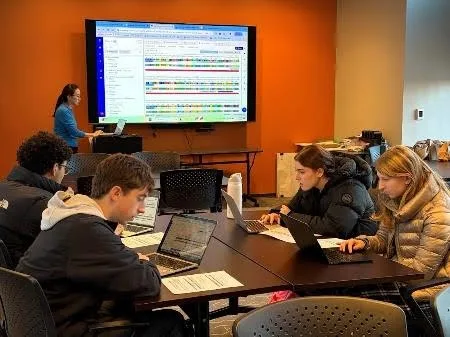
The students ran an experiment that edited a specific gene in yeast cells that, if successful, would cause the cells to turn red. The team did not get red colonies initially. So, their next step was troubleshooting by modifying the protocol and designing a new donor DNA.


This do-learn-revise sequence is just what biotechnologists do as they look for bio-based solutions to real-life needs.
BioBuilder is delighted to help students and schools dive into synthetic biology!
