
In the BioBuilder world, “March Madness” means BioBuilderClub Final Assembly time!
It’s a month full of excitement as BioBuilderClub teams gather to share and celebrate their bioengineering projects and accomplishments.
This year, a total of 501 students from 48 different schools participated in BioBuilderClub. The students formed 82 teams that worked from October through March developing their own unique biotechnology research and design projects.
The students and teams were located across the U.S. and in other countries:
- 176 Massachusetts students in 28 teams
- 162 Southeast U.S. students in 23 teams
- 167 students from other countries in 31 teams
The U.S. teams hailed from 13 States:
- Georgia
- Tennessee
- North Carolina
- Illinois
- Michigan
- Ohio
- Kansas
- Massachusetts
- New Hampshire
- Connecticut
- Pennsylvania
- New Jersey
- California

The international teams came from Spain, Taiwan, and China.

Each team was paired with an industry mentor who provided them with project help and guidance. This year we had 56 mentors from 43 different life science organizations. We are so happy to have these dedicated, knowledgeable mentors who gladly contribute their time and expertise to support our future science pros!
After six months of working on their projects, the teams were invited to attend a Final Assembly to present their work and celebrate their success. Final Assemblies were held in two locations this year – Boston and Atlanta.
Boston Final Assembly
The Boston Final Assembly was held on March 12 at the Ragon Institute. Fifty BioBuilderClub teams attended the Boston event either in-person or virtually. The students invited their families, friends, teachers, and other supporters to join them. So, in addition to the other teams, mentors, and BioBuilder folks, the audience included 186 in-person attendees and 100 attendees watching the livestream.


Each team presented their project in a poster session and by giving a one-minute Lightning Talk presentation. The virtual attendees were able to interact with the teams during the poster sessions and presentations using Discord.


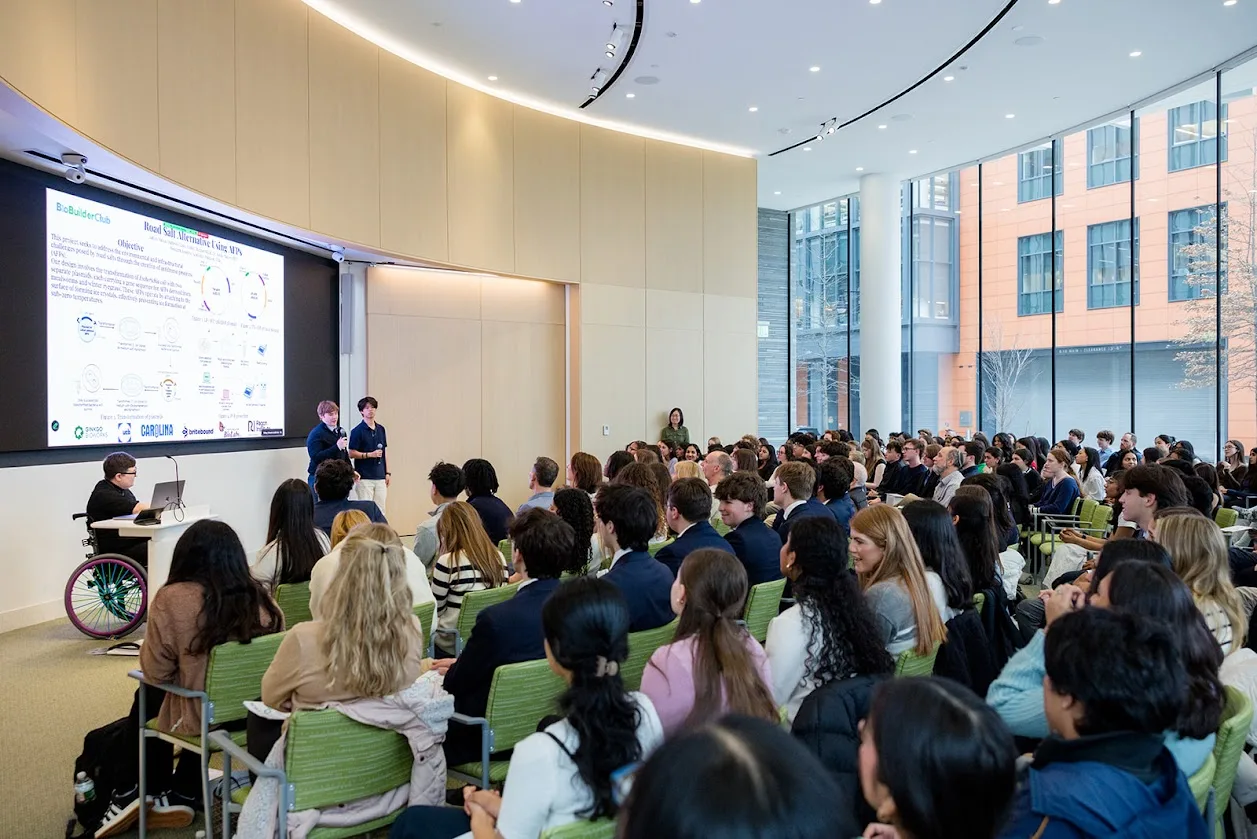
The teams really wowed the audience with their innovative projects and dedicated work! A few examples of the biotech projects these teams developed include:
- Bioremediation of lead using E. coli
- Combating surgical site infections with sutures coated in phage-derived depolymerase
- Low-cost visual diagnostic for colorectal cancer using a bacterial biosensor
- Developing hypoallergenic birch tree lines
- Boosting bacterial cellulose production for biomaterial development
- Combating invasive zebra mussels by silencing byssal thread genes
- A biosensor for detecting heavy metal contamination in cosmetics
- Using anti-freezing proteins for deicing, cryopreservation, and food science
The evening was full of excitement and admiration for these ambitious young bioengineers!


Southeast Final Assembly
The Southeast Final Assembly was held on March 26 at the Brookhaven City Centre in Atlanta. Nineteen BioBuilderClub teams from schools in Georgia, Tennessee, and North Carolina attended the Atlanta event. In addition to the students, mentors, and BioBuilder folks, the audience also had 140 other attendees including student families, friends, teachers, and other supporters.


Each team presented their project in a poster session and by giving a one-minute Lightning Talk presentation.


A few examples of the biotech projects these teams developed include:
- Engineering bacteria to optimize nutrient fixation and solubilization in soil
- Developing a rapid, low-cost CRISPR-based test to make early pancreatic cancer detection more accessible
- Preventing or delaying senescence in carnations to increase shelf life
- Engineering Lactobacillus paracasei to produce flavor esters
- Developing a malaria diagnostic test that can detect the 15% of cases that current tests miss
- A non-invasive test to diagnose and stage diabetic retinopathy
- Combating forest fires by reducing ladder branch fuels through engineering trees with light-sensitive ethylene production to drive branch abscission at low light levels
- Engineering Lactobacillus plantarum probiotics to reduce atherosclerotic plaques
- A biosensor for the oil found in poison ivy that could be used in a topical product to alert users to poison ivy exposure
- A sustainable biofuel production system that converts invasive plant biomass into biodiesel
- Reducing urban pollen-related respiratory allergies by suppressing pollen production in white oak trees using RNA interference delivered through spray-applied BioClay nanoparticles
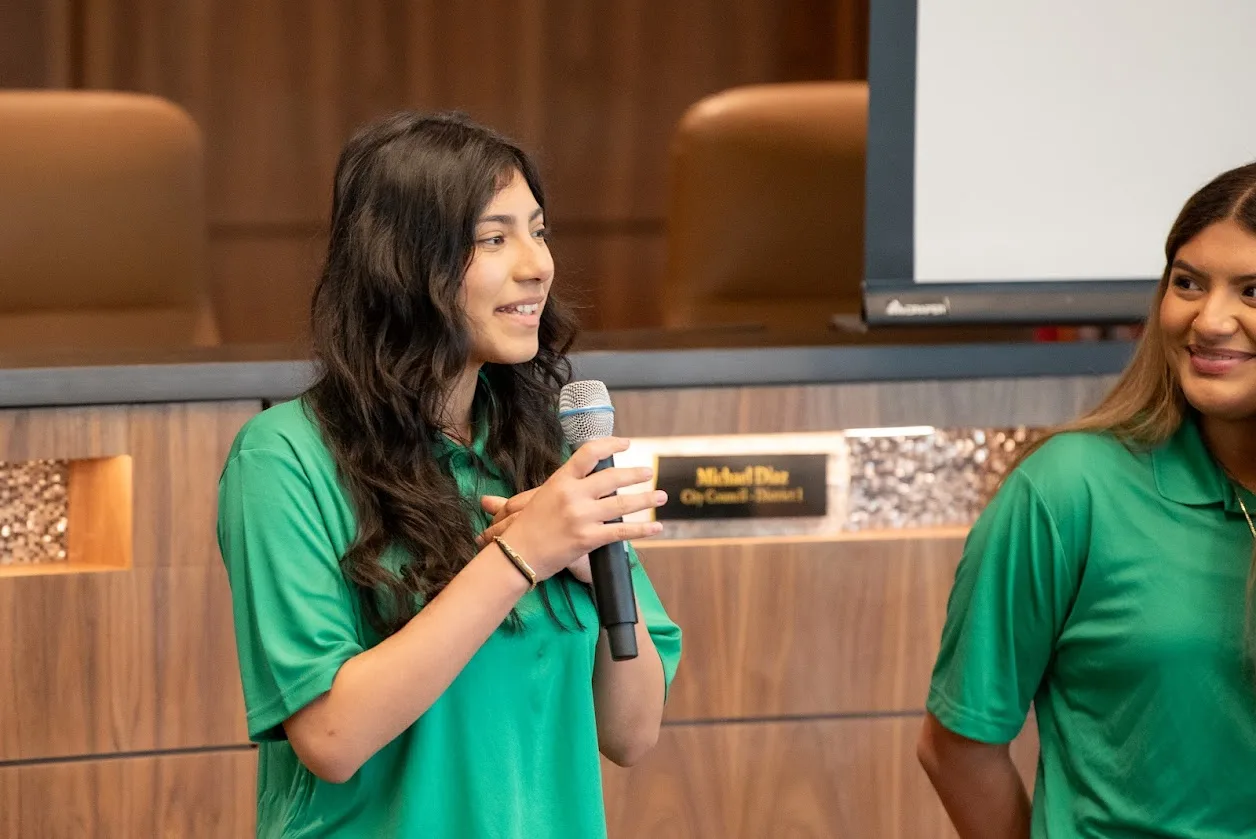

The audience was captivated by the in-depth work of these dedicated, creative teams. And they were so proud of their high schoolers!

Ready to Join the BioBuilderClub Jam?
Are you a student, teacher, or otherwise interested in learning more about BioBuilderClub? Check out our BioBuilderClub page for more information.
Registration for the 2026-2027 BioBuilderClub opens in August. But you can start inquiring by reaching out to us now.
Let’s talk BioBuilderClub!
The Allston Lab keeps going, and going, and going…
The Learning Lab @Allston Labworks certainly is staying busy as their second year of operations continues! (ICYMI, check out the “learning and doing” completed in Year 1 at the Allston Lab).
Spring High School Apprenticeship Challenge

Just two weeks ago, on March 14, the spring cohort of BioBuilder’s HSAC kicked off at the Allston Lab. The 24 apprentices will spend eight Saturdays at the lab building hands-on, professional skills to accompany their Thursday online learning sessions.

We can’t wait to see what they accomplish!
Pi Day Workshops
In collaboration with Harvard Ed Portal, BioBuilder held Pi Day workshops on March 20th at the Allston Lab. Pi Day is celebrated on March 14 to correspond with the first three digits, 3-1-4, of the intriguing mathematical constant.
The Ed Portal sponsored 59 eighth graders from Brighton High School in Boston’s Allston-Brighton neighborhood for the Pi Day program. As part of the programming, BioBuilder led one-hour workshops with the students, and the Ed Portal held other learning sessions at their facility. The students formed two groups that alternated mornings and afternoons at the Allston Lab and the Ed Portal.

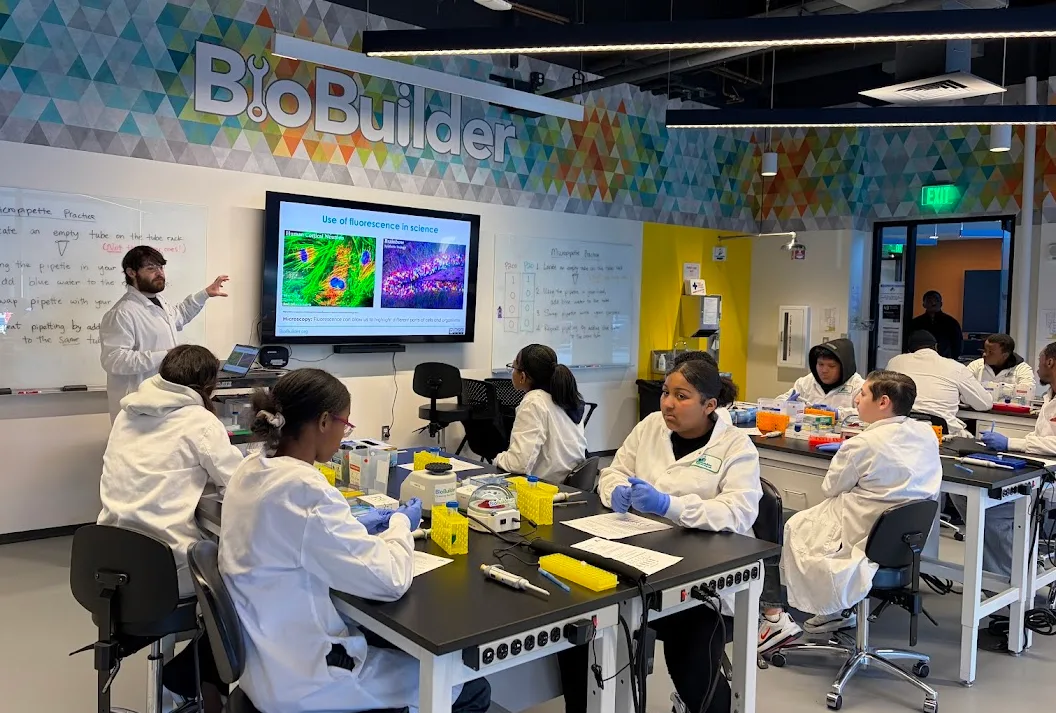

BioBuilder tailored the Guiding Light curriculum to fit in the one-hour sessions and adjusted the content for 8th grade level. Students learned about the uses of pipettes in the lab and built hands-on skills by practicing pipetting. For 99% of the students, it was their first time pipetting and they had a blast!
One of the school’s science teachers sent this note to BioBuilder afterwards:
“Thank you very much for everything you and your team did to set up an awesome day for our 8th graders. I especially appreciate your willingness to tailor the experience to meet students where they are.”
This is the kind of young student nurturing BioBuilder supports for their home area of Boston, and envisions for other communities across the U.S.
Stay tuned to the BioBuilder blog to keep up with the “learning and doing” that keeps growing at the Learning Lab @Allston Labworks!